
The Limits of “the Public“. Homelessness, Visibility, and Management of Survival in Cologne Neumarkt
The Oxford English Dictionary defines public as “relating to or involving people in general” or “open to all,” while space is defined as “an empty or available area.” Together, these definitions describe public space as an area intended for communal use that is freely accessible to “the public”, regardless of economic status. In democratic societies, public spaces are commonly understood as places of encounter, movement, leisure, and participation.
Yet this ideal immediately raises a question: who is actually included in “the public”? Although public spaces are imagined as universally accessible, access is not equally experienced. The ability to remain, rest, or simply exist in public space is unevenly distributed, and some forms of presence are considered more legitimate than others.
For those unfamiliar with Cologne, Neumarkt is a central public square that connects one of the city’s main shopping districts with one of its busiest public transportation hubs. Every day, thousands of commuters, shoppers, tourists, and residents pass through the square. For most of them, Neumarkt functions as a place of movement, leisure, and everyday convenience. They use the tram station to travel across the city, wait on benches, visit nearby shops, access cultural institutions, shelter from rain, use public toilets, or simply spend time in the area.
For people experiencing homelessness, however, access to this same urban infrastructure is far less straightforward. Many of these spaces are only temporarily available, regulated, or practically inaccessible. As a result, everyday life involves constant movement across the city in search of services distributed across different locations: soup kitchens, day centres to shower or wash clothes, public toilets, social welfare offices for administrative appointments, medical services, emergency shelters, and places where it is possible to ask for money or collect bottles. Because public transport in Cologne is expensive and travelling without a valid ticket can lead to fines, criminal charges, or even imprisonment for those unable to pay, many of these journeys take place on foot.
These inequalities, I argue, are produced through the ways homelessness is discussed and governed. Political speeches, media reporting, and institutional communication repeatedly distinguish between “the public,” whose safety, comfort, and mobility must be protected, and those whose presence is framed as a problem to be managed. In these narratives, homelessness frequently appears alongside terms such as Sicherheit (security) and Sauberkeit (cleanliness), framed primarily as an aesthetic and public-order issue.
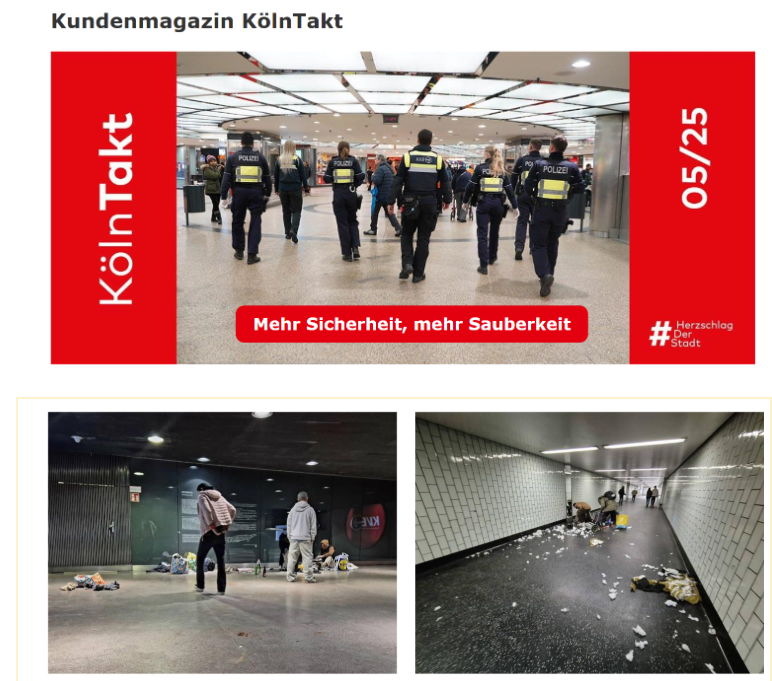
One example that particularly stayed with me appeared in a WDR article reporting on the KVB’s new security measures. One section is titled simply: “Dreck, Müll und Fäkalien” (“Dirt, Garbage, and Feces”). The article explains that people experiencing homelessness leave behind rubbish and human waste in underground stations, making them “an imposition for passengers” and a problem for operational safety. Alongside this section is a photograph of a man sleeping alone in an underground station.
This juxtaposition illustrates not only how homelessness is reduced to questions of cleanliness and security, but also how this reduction can become dehumanizing. Placing the image of a sleeping man directly beside a section titled “Dirt, Garbage, and Feces” invites readers to associate his presence with urban filth rather than with a human being in need of shelter.
Equally striking is what remains unsaid. The article never mentions that public toilets in the areas most frequently associated with homelessness require payment. Nor does it acknowledge the lack of safe places where people can store their belongings, attend to basic hygiene, or sleep while protected from rain, cold, or heat necessary to survival and human dignity.
The dehumanization of people experiencing homelessness is reinforced not only through aesthetic framings of disorder and cleanliness, but also through moralizing narratives that distinguish between the deserving and the undeserving.
A striking example comes from German Chancellor Friedrich Merz. During a debate on tightening Germany’s welfare system in October 2025, he stated: “Es wird in Deutschland niemand obdachlos. Jeder, der eine Wohnung oder ein Dach über dem Kopf braucht, bekommt ein Dach über dem Kopf.” (“Nobody becomes homeless in Germany. Anyone who needs a home or a roof over their head gets one.”) Although the discussion concerned proposed changes to welfare benefits rather than homelessness itself, by claiming that nobody needs to be homeless in Germany, it implicitly suggests that those who are homeless are responsible for their own situation, that they have chosen it, failed to accept available help, or simply do not want to change it.
The context in which this statement was made is equally revealing. The statement took place as part of a debate advocating stricter welfare sanctions. This logic in which poverty is framed as the outcome of individual failure, places the role of the state in shaping social policies to protect people from poverty into the background.
Moralization further operates through images and dichotomies. It divides society into those who contribute and those who depend (those who work and those who refuse to work, those considered deserving of solidarity and those perceived as exploiting it). These categories establish moral boundaries around who is considered a legitimate member of society and who is not.
Katrin Lehnert traces this logic through the figure of the Sozialschmarotzer (“welfare parasite”), a recurring character in German political and media discourse. The Sozialschmarotzer is not a clearly identifiable social group but a discursive figure onto which anxieties about work, productivity, and the welfare state are projected. Through this figure, structural questions of poverty and social inequality become condensed into the image of an individual who is unwilling to contribute and who lives at the expense of others.
At the same time, the discourse constructs an complementary image: the honest taxpayer. Lehnert shows that these figures are produced together. The image of the hardworking citizen who finances the welfare state gains meaning through contrast with the imagined welfare parasite who is said to abuse it. This distinction creates a moral community built around productivity and economic contribution, making access to solidarity increasingly dependent on whether someone is perceived as giving back to society.
A final manifestation of this moralizing logic emerged repeatedly during my fieldwork. Across conversations with people from very different backgrounds, I often heard the same explanation for why they preferred not to give money to people experiencing homelessness. Many said they would rather buy food because they feared the money might be spent on drugs. Whether or not someone chooses to give money is, of course, a personal decision. What is analytically significant, however, is what this recurring justification reveals about broader moral understandings of homelessness.
Although intended as a compassionate decision, this reasoning reveals a deeper moral judgement about who deserves autonomy and under what conditions help should be given.
To begin with, the assumption that every person experiencing homelessness uses drugs is simply inaccurate, even though substance dependency does affect a significant proportion of this population. More importantly, however, this argument reduces people’s needs to the bare minimum required for survival. It assumes that food is the only legitimate expense, overlooking the countless everyday necessities that also require money such as medication, hygiene products, laundry, public toilets, transportation, a safe place to spend the night.
Underlying this reasoning is the idea that people experiencing homelessness must continually prove that they are deserving of assistance. Unlike others, they are expected to justify every purchase and every decision.
Finally, drug use often functions as a moral marker within these discussions. Addiction becomes evidence of irresponsibility or undeservingness, while its medical dimensions and the complexities of substance dependence receive far less attention. This framing obscures the realities of addiction, including the fact that abrupt withdrawal from certain substances can be dangerous and, in some cases, life-threatening.
“The CDU parliamentary group is committed to reducing the presence of large groups of people experiencing homelessness in heavily frequented areas such as Cologne’s city centre. Public spaces should be safe and welcoming for citizens and visitors. We therefore call for targeted clearances (gezielte Räumungen) and exclusion orders (Platzverweise) at specific ‘hotspots,’ particularly Neumarkt, Ebertplatz, Schildergasse, Hohe Straße, Wallrafplatz, and along the Rhine promenade.” (CDU Parliamentary Group of the City of Cologne, Overcoming Homelessness in Public Space Sustainably, 2025, p. 2)
Once people experiencing homelessness have been reduced to an aesthetic disturbance, a security concern, or a moral failure, the problem is no longer understood as homelessness itself, its visibility. The objective shifts from addressing the conditions that produce homelessness to removing its presence from public view.
This process of invisibilization operates on multiple scales. At the everyday level, it appears in small acts of avoidance: looking away, avoiding eye contact, pretending not to hear when someone asks for help, or using a phone as a way to withdraw from an uncomfortable encounter and extends to more systematic forms of displacement.
In Cologne, this displacement operates through two interconnected mechanisms. The first consists of urban cleansing: the removal of people from highly visible public spaces in order to restore an image of order, cleanliness, and safety. The second relies on surveillance and exclusion, implemented through increased police and Ordnungsamt presence, intensified controls, and Platzverweise (exclusion orders) that regulate who is permitted to remain in particular spaces.
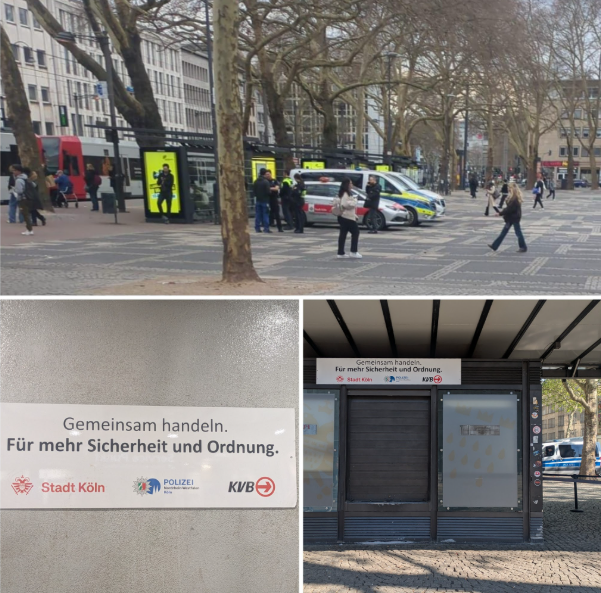
These practices have become particularly visible around Neumarkt through the KVB’s SOS (Service, Ordnung, Sicherheit) initiative, a joint operation involving KVB security staff, the police, and the Ordnungsamt. Officially, the initiative aims to improve safety, order, and service for passengers. In practice, however, one of its central effects has been the systematic displacement of people experiencing homelessness from one area of the city to another.
Interviews published in Frauen zwischen Straße und Strafe (Women between the Streets and Punishment) with people experiencing homelessness describe having their sleeping bags, blankets, clothing, medication, and personal belongings removed. One woman recalls, “All my clothes were gone. No sleeping bags, nothing left.” Another remembers asking the Ordnungsamt what had happened to her belongings only to be told, “That’s not my problem.”
This ‘’invisibilization goal’’ also emerged during my interview with a volunteer working with people experiencing homelessness. He described receiving calls through the Kältebus (a mobile service that supports people sleeping outside during the winter) because residents want someone sleeping outside their building to be “removed.” When volunteers arrived, however, they often found that the person did not need removal but a sleeping bag, warm clothing, medical assistance, transport to emergency accommodation, or simply someone to check on their wellbeing.
What frustrated some callers, the volunteer explained, was not necessarily that someone lacked protection from the cold. The frustration often remained even after help had been provided, as long as the person was still there.
Survival
People experiencing homelessness rely on highly localized networks of support, and being moved away from familiar places can disrupt access to those networks. Outreach workers may no longer know where someone is sleeping, established routes to food distribution, medical care, public showers, or emergency accommodation are interrupted, and relationships built through repeated encounters become increasingly fragile.
Having items confiscated also pose a life threat. Blankets, warm clothing, or medication can determine whether someone safely survives another night outdoors. Taken individually, many of the practices discussed throughout this essay appear administrative rather than violent. Considered together, however, they reveal a broader political logic that regulates the access to conditions through which survival is possible.
This perspective resonates with Achille Mbembe’s concept of necropolitics. Building on and extending Michel Foucault’s notion of biopolitics, Mbembe argues that sovereignty is ultimately expressed through the power to determine “who may live and who must die.” More importantly for this analysis, he draws attention to forms of power that do not necessarily kill directly but instead expose particular populations to conditions in which life becomes increasingly precarious. Necropolitics operates through the production of what Mbembe calls “death-worlds”: spaces where people are compelled to live in conditions that continually threaten life and reduce it to mere survival.
The practices described in this essay do not amount to direct physical violence, but the very resources upon which survival depends. Governing homelessness therefore extends beyond controlling where people may sleep or remain visible but it becomes a way of governing the infrastructures that make life possible.
Furthermore, the material presented suggests that the management of homelessness in Cologne increasingly operates through this logic. Considerable institutional resources are devoted to monitoring, regulating, and relocating people experiencing homelessness, while much of the work required to sustain life remains dependent on volunteers, churches, outreach organizations, and informal networks of solidarity.
If, as Mbembe argues, sovereignty is ultimately expressed through the capacity to shape the conditions of life and death, then the practices examined here reveal a subtle but powerful form of necropolitical governance: one that does not kill directly, but continuously determines whose lives are protected, whose suffering is tolerated, and whose survival is left to depend on endurance, charity, and chance.
If you would like to help or if you need help
Alongside practices of surveillance, displacement, and invisibilization, Cologne is also home to countless individuals and organizations working every day to support people experiencing homelessness with dignity, care, and solidarity. Much of the work of providing food, shelter, medical assistance, counseling, and pathways into housing is carried out by dedicated volunteers, outreach teams, social workers, and local initiatives.
Whether you are looking for ways to get involved, would like to support these organizations, or are experiencing homelessness yourself and are looking for assistance, the following resources may be a useful starting point:
– Freude der Kölner Straßen und ihrer Bewohner e.V. (see here)
– SKM Köln e.V. (see here)
– Sozialdienst katholischer Frauen e.V. Köln (see here)
– Oase (see here)
– Mobiler Medizinischer Dienst der Stadt Köln (see here)
– Caya e.V. Köln (see here)
– Matteser Medizin für Menschen ohne versicherung (see here)
– Pace und Bene Stiftung (see here)
– HiK – Heimatlos in Köln e.V. (see here)
Lehnert, Katrin. 2009. „Arbeit, nein danke!?“ Das Bild des Sozialschmarotzers im aktivierenden Sozialstaat (München: Herbert Utz).
Mbembe, Achille. 2003. ‘Necropolitics.’ Public Culture 15(1), 11–40.
Metzger, P., and C. Niesel. 2025. Frauen zwischen Straße und Strafe: Wenn Freiheit Obdachlosigkeit bedeutet (Köln: Weissmann Verlag).
I am Bruna, a Master’s student in Transcultural Studies at the University of Bonn.
Questions of homelessness, housing, and social inequality have long been close to my heart. This project gave me the opportunity to listen, learn, and reflect on how homelessness is experienced and understood from different perspectives.
I sincerely thank everyone who trusted me with their stories and made this research possible.
Hier findest du weitere Projekte: